
The tool suite
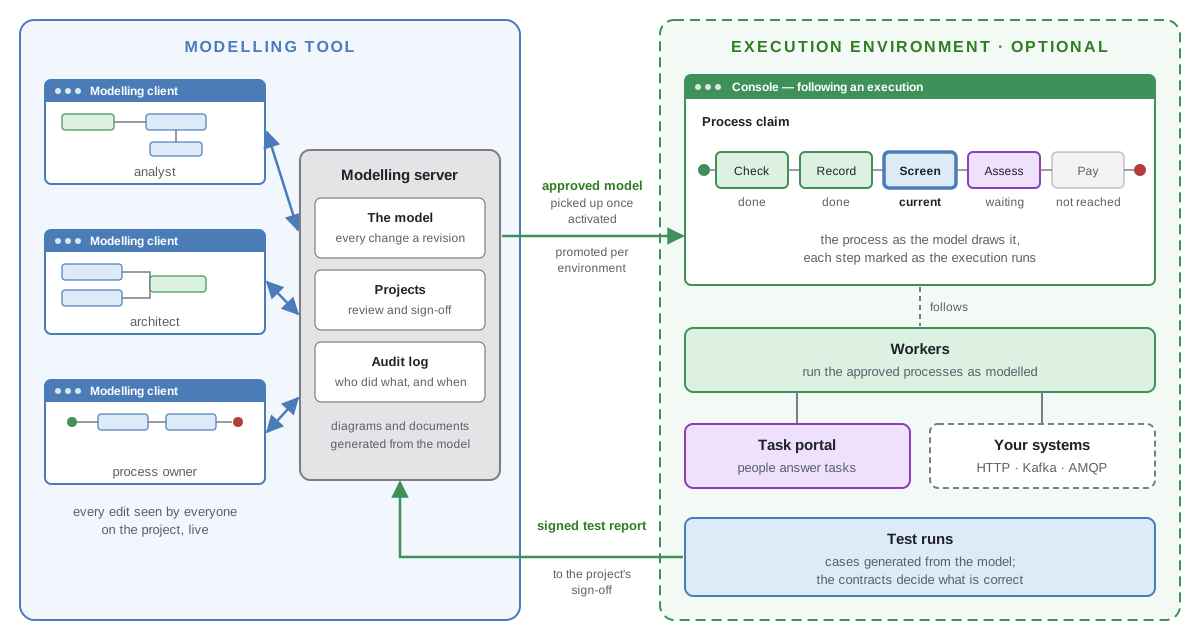
The suite has two parts. In the modelling tool, your team specifies and designs your services together, in one model from which every diagram and document is drawn. The optional execution environment runs and tests the approved model itself.
At a glance
- One artifact, the business model
- Real-time co-editing, every change a git revision
- Diagrams laid out by the engine, never by hand
- AI assistance, under your control
- Continuous and gated model verification
- Descriptive, specified and executable levels
- Entities changed only through their owner's services
- Human, internal or external providers, switched at will
- Tests generated and run before sign-off
- Providers held to contract by Contract Verifying Interceptors
- Processes executed, with generated human and system adapters
- Monitorable, auditable executions
- Compliance, auditability and privacy built in
- Integrates with your OIDC single sign-on and CI/CD
- BPMN and DMN import and export
- An open, published model specification
Model once
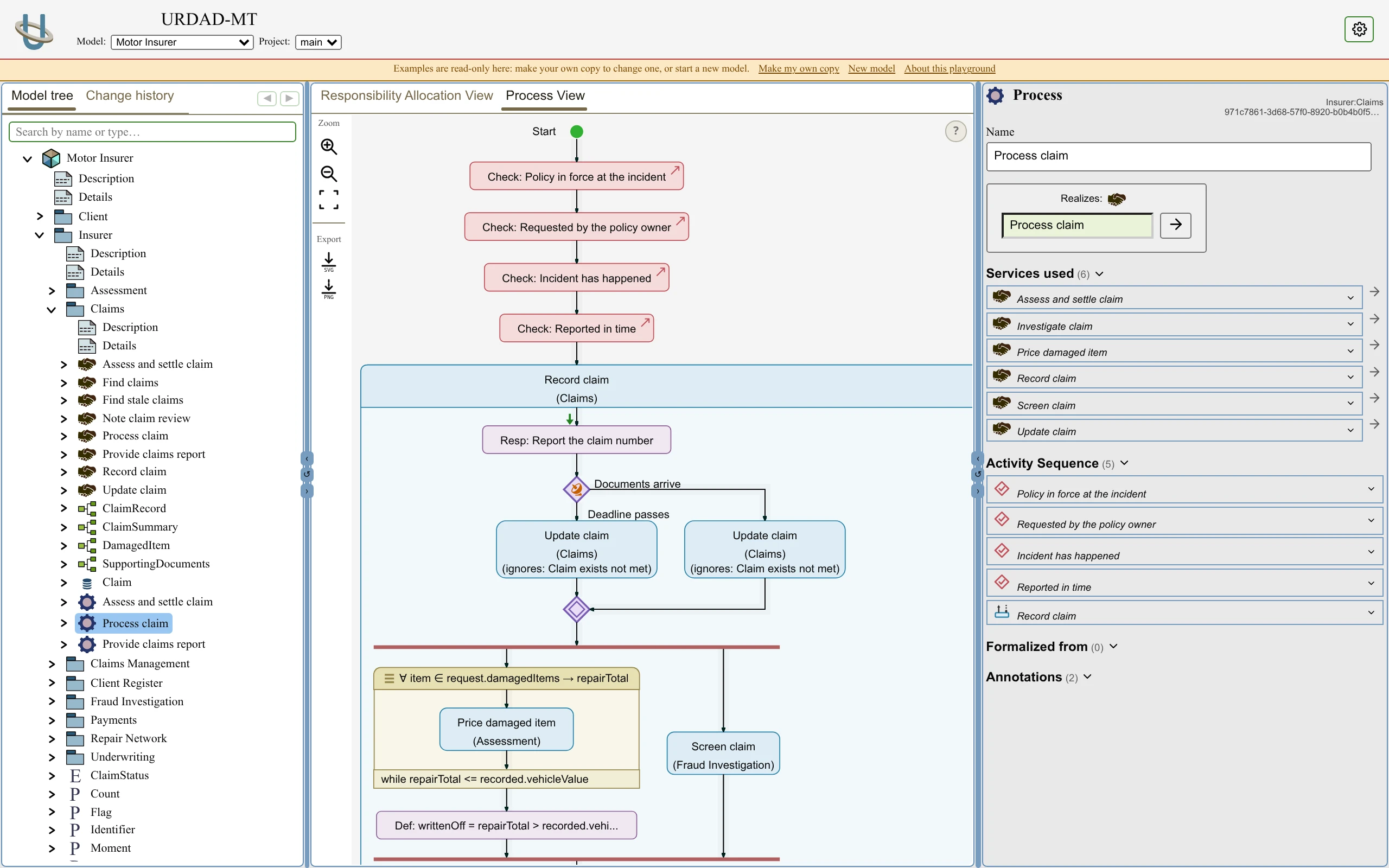
One model of what your services must do and how, from which every diagram and document is drawn, shared by everyone at once.
- Nobody draws or redraws a diagram; every view is generated from the model.
- A team edits the same model together, live, with every change recorded.
- Each process is checked against its requirements as you work.
Govern change
Every change is reviewed, approved and recorded before it takes effect, which gives the evidence an auditor asks for.
- The model changes only through projects, each taken through phases to sign-off.
- Roles say who may do what; regulated projects add the checklists their rules require.
- A permanent record of who changed, reviewed and approved what.
Execute and test
Optionally, run and test the approved model itself, so that what was specified is what runs and the tests come from the model.
- The approved processes run as modelled, with no hand-written program to drift from them.
- Tests are generated from the model, so nobody writes a test, a stub or a data set.
- Every answer is checked against its contract, and the party at fault is named.
Share and integrate
The model reaches the rest of your organisation as documents, as files which other tools read, and through the systems you already run.
- Documentation generated from the model, and published where your people already read.
- Processes and decisions to and from BPMN and DMN, so you are never locked in.
- Connects to your identity, delivery, secrets and AI providers without tying you to one vendor.
Tests nobody writes
With BPMN, each test is written by hand and states for itself what the process should achieve. In URDAD the service contracts decide what is correct, so the execution environment generates the tests from the model.
- Every case found for you. Each request is accepted, and refused for every reason it may be, down every branch of the process and through every refusal of the services it uses.
- Each process alone, then all together. The services a process uses answer as their contracts say they would, and the processes then run as one.
- Coverage you can show an auditor. It is given per service, condition by condition where a regulation demands it, with every gap and its reason.
- Signed evidence for sign-off. The report is signed by the environment that produced it, and a project's testing phase is signed off on it.
See it
Already using BPMN? See how URDAD compares, including when BPMN is the better choice.
Where URDAD fits: For DDD teams · For financial services.